Lin Ma
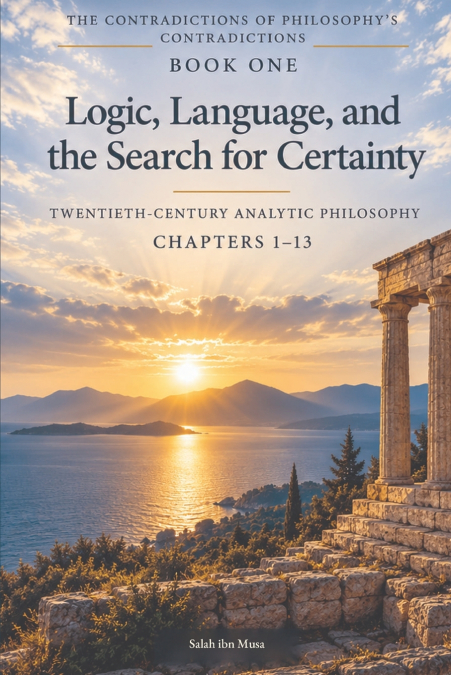
Logic, Language, and the Search for Certainty examines the first great movement of twentieth-century analytic philosophy: the attempt to secure philosophical clarity through logic, linguistic analysis, formal systems, and increasingly rigorous standards of justification.Beginning with Frege, Russell, and Moore, the book follows the development of analytic thought through early Wittgenstein, the Vienna Circle, Carnap, Tarski, Gödel, and Quine. It explores how these thinkers transformed philosophy by demanding greater precision in the relationship between language, logic, knowledge, and reality.Yet the search for certainty also revealed limits within the very methods designed to achieve it. Formal systems encountered boundaries; distinctions between analytic and synthetic truth came under pressure; and increasingly sophisticated accounts of language raised new questions about what can be meaningfully stated, demonstrated, or known.The book argues that these developments should not be understood simply as the failure of analytic philosophy. Rather, they reveal a deeper philosophical lesson: a method becomes most powerful when its scope, assumptions, and limits are made explicit.As Book One of The Contradictions of Philosophy’s Contradictions, this volume establishes the foundation for a three-book inquiry into logic, language, science, practice, human agency, and responsibility. It asks not only how philosophy pursued certainty, but what philosophy discovered when the pursuit of certainty encountered its own boundaries.Written for readers of philosophy, intellectual history, and contemporary debates about formal reasoning and artificial intelligence, the book connects one of the most influential philosophical traditions of the modern era with questions that remain urgent today.