Ray-Ray Lalonde
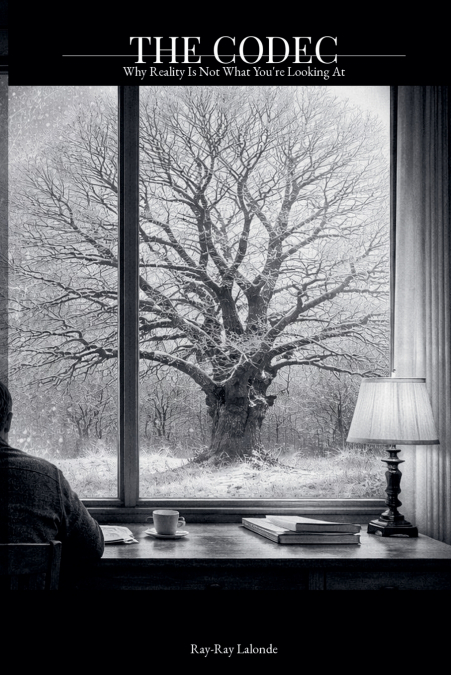
There is an apple on the table. It is red. And the redness is nowhere in the apple.Not in its skin, not in the light bouncing off it, not anywhere in the physical world. Remove every eye and every brain from the universe and the light is still there, exactly as it was. The red is gone. Not hidden. Gone.The Codec begins with that ordinary moment of looking and follows it to one of the strangest conclusions in philosophy: that the world you experience is not a copy of reality - not even a distorted one. It is a translation, produced by a system that converts physical signals into experience the way a video codec turns ones and zeros into a film. And like any codec, it cannot show you its own workings, or what it was given to work with.Drawing on the neuroscience of predictive processing, Donald Hoffman’s interface theory, Kant, the enactivists, and the physics of information, the book builds a single framework - and then pushes it to its edge. If every tool we have for investigating reality was built inside the translation, what can those tools never reach? The answer is the Kernel Thesis: a precise account of the boundary between what can be known and what, structurally, cannot.Along the way it takes on dreams, false memories, UFO sightings, artificial minds, brain implants that create perception directly, and the question of whether a machine could ever be conscious.This is not a book about doubting your senses. Perception is extraordinarily reliable. It is a book about understanding what perception actually is - and finding that the answer makes ordinary experience stranger and more remarkable, not less.This revised edition corrects and updates the original throughout, and adds a short formal statement of the framework for readers who want the argument made exact.The first book in the Reality series, followed by The Syntax of Nothing and The Compiler.