Wanhong HUANG
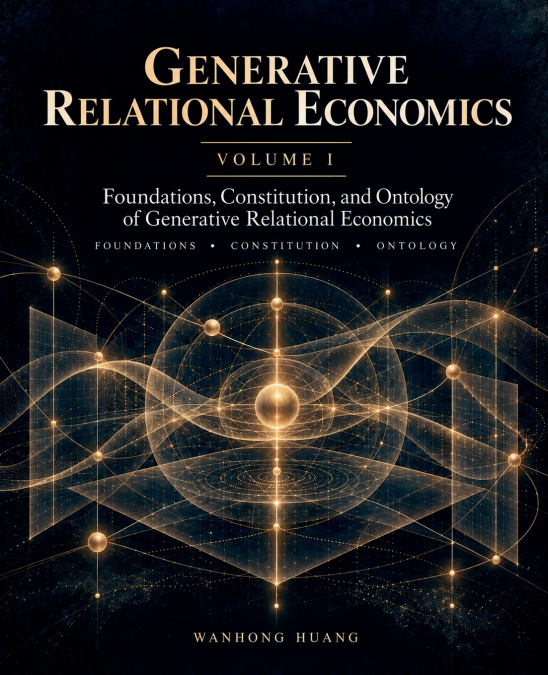
This volume establishes the historical, intellectual, and ontological foundations of Generative Relational Economics (GRE). It begins by examining the historical conditions through which modern economic objects, subjects, institutions, categories, and forms of scarcity became constituted and analytically intelligible. Economic concepts are therefore approached as historically situated formations rather than as context-independent primitives.The volume subsequently reconstructs a broad intellectual genealogy relevant to GRE, including traditions concerned with relation, process, emergence, social facts, subject formation, value, political economy, institutions, capabilities, care, commons, evolutionary and ecological economics, complexity, networks, dynamical systems, fields, information, computation, and formal representation. These traditions are placed in dialogue without presuming their theoretical equivalence.The volume then develops GRE as a distinct but open research programme and introduces its foundational ontological architecture. Ultimate ontological reality remains suspended rather than conclusively specified. Analytical attention is instead directed toward relational reality, in which historically constituted and sufficiently stable relational beings and structures can acquire causal and generative efficacy, and manifestation reality, through which such structures become contextually presented, perceived, represented, interpreted, and acted upon.These foundations provide the conceptual basis for the epistemological, methodological, and substantive economic analyses developed in subsequent volumes. GRE is presented throughout as a revisable programme rather than a closed metaphysical or economic system.