Wanhong HUANG
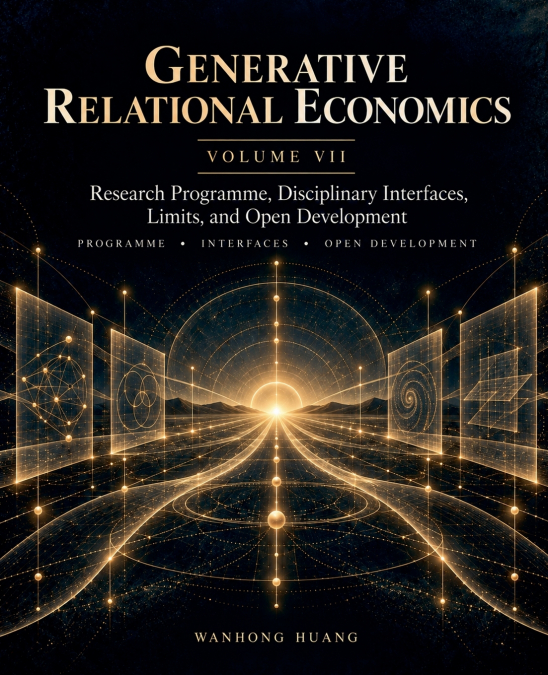
This concluding volume situates Generative Relational Economics within broader economic inquiry and articulates its future development as an open, historically revisable research programme. It consolidates research questions, empirical strategies, formal problems, institutional applications, and methodological priorities that can guide subsequent GRE research without converting the framework into a closed theoretical canon.The volume examines GRE’s interfaces with neighboring domains including history, governance, law, political theory, education, ecology, artificial intelligence studies, social theory, and aesthetics. These relations are treated as disciplinary interfaces rather than as grounds for theoretical absorption. Concepts may travel across domains only through explicit translation, and apparently general structures may prove domain-specific when confronted with different objects, histories, normative problems, or evidential conditions.A sustained analysis of limitations addresses ontological, epistemic, representational, relational, historical, formal, empirical, value-theoretical, power-theoretical, justice-related, application-oriented, AI-era, and domain-transfer problems. The volume also identifies failure modes, normative underdetermination, conditions that would count against particular GRE claims, and circumstances under which substantial theoretical revision would be required.The concluding account therefore understands GRE as an open research programme whose development depends upon empirical confrontation, theoretical dialogue, preservation of uncertainty and negative results, explicit disciplinary boundaries, and continuing re-epistemization. The programme’s continuity lies in its capacity for disciplined revision rather than in the preservation of an immutable theoretical system.