Inicio > > Programación informática/desarrollo de software > Autonomous Agentic AI Security Architecture
Autonomous Agentic AI Security Architecture

Autonomous Agentic AI Security Architecture

Devlin Nexley

29,32 €
IVA incluido
Disponible
Editorial:
Devlin Nexley
Año de edición:
2026
Materia
Programación informática/desarrollo de software
ISBN:
9785697213315
29,32 €
IVA incluido
Disponible
Añadir a favoritos

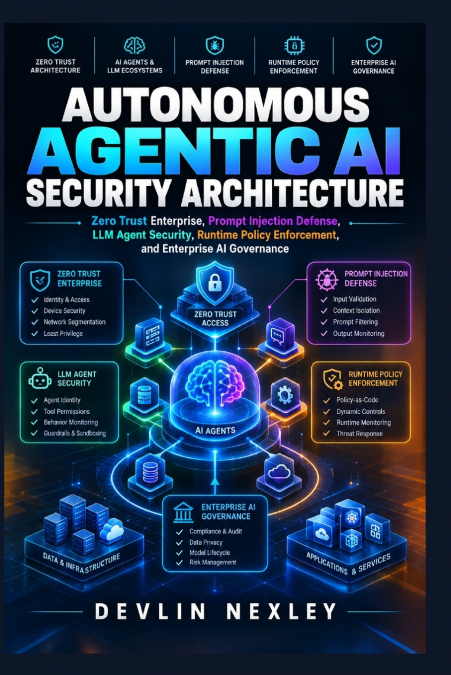
Autonomous AI systems are moving beyond generating text and recommendations into environments where they can plan tasks, invoke tools, access enterprise data, modify systems, and coordinate with other agents. This shift creates a fundamentally different security problem: organizations must secure not only AI models and applications, but the autonomous execution layer surrounding them.This book presents a security engineering approach to designing, deploying, governing, and operating agentic AI systems in production environments. It examines how identity, authorization, runtime policy enforcement, Zero Trust principles, threat modeling, observability, and containment must evolve when software can make decisions and initiate actions dynamically.The architecture moves from the agent runtime and its trust boundaries through the major attack surfaces created by autonomous execution. It examines prompt injection, indirect instruction attacks, memory poisoning, retrieval manipulation, tool exploitation, credential abuse, data leakage, agent impersonation, and threats emerging from multi-agent collaboration. Rather than treating these as isolated vulnerabilities, the book analyzes how individual weaknesses can combine into larger attack paths across agent workflows.Particular attention is given to secure agent identity and delegated authorization, capability-based access control, policy-as-code, tool gateways, sandboxed execution, memory isolation, retrieval security, secrets management, and continuous verification. The discussion also examines how Zero Trust architecture can be adapted for autonomous agents by separating identity, intent, authorization, execution, and trust decisions.The book then moves into operational security. Agent telemetry, behavioral analytics, security operations, decision-path monitoring, incident response, execution freezing, identity quarantine, context rollback, memory recovery, and progressive privilege restoration are examined as components of an operational model for autonomous systems. These mechanisms are considered alongside enterprise governance, auditability, accountability, risk management, and compliance requirements.Designed for security architects, AI engineers, platform engineers, DevSecOps teams, enterprise architects, security leaders, and technology executives, this book provides an architecture-first perspective on securing AI agents at enterprise scale.Topics include:• Agent runtime security and autonomous execution architectures• Threat modeling for autonomous AI systems• Agent identity, authentication, delegation, and authorization• Zero Trust architecture for AI agents• Prompt injection and indirect instruction defense• Memory security and knowledge poisoning• Secure tool and function execution• Retrieval-augmented generation security• Multi-agent trust and inter-agent communication• Secrets and sensitive-data protection• Runtime policy enforcement and capability controls• Agent observability and behavioral security analytics• Security operations for autonomous AI environments• Incident response, containment, and recovery• Enterprise AI governance, auditability, and risk management• Resilient security architectures for production agentic platformsThe central engineering challenge is not simply preventing an AI agent from behaving incorrectly. It is designing an environment in which autonomous systems can operate with useful levels of capability while their identities, permissions, decisions, data access, and external actions remain continuously controlled and observable.

Artículos relacionados

  • SPARK 2014 Reference Manual
    AdaCore / Altran UK Ltd
    SPARK 2014 is a programming language and a set of verification tools designed to meet the needs of high-assurance software development. SPARK 2014 is based on Ada 2012, both subsetting the language to remove features that defy verification, but also extending the system of contracts and aspects to support modular, formal verification.This manual is available online for free at ...
    Disponible

    19,91 €

  • Software and Intelligent Sciences
    Yingxu Wang
    The junction of software development and engineering combined with the study of intelligence has created a bustling intersection of theory, design, engineering, and conceptual thought. Software and Intelligent Sciences: New Transdisciplinary Findings sits at a crossroads and informs advanced researchers, students, and practitioners on the developments in computer science, theor...
  • Power System Planning Technologies and Applications
    Fawwaz Elkarmi / Nazih Abu Shikhah / Nazih Abu-Shikhah
    Planning is an important function of the management of any business, providing knowledge of future prospects and enabling prudent and appropriate decision-making. Planning is especially critical for power systems, since electricity is a fundamental part of modern societies and many conventional electrical energy resources currently in use are limited. Power System Planning Tech...
  • Concept Parsing Algorithms (CPA) for Textual Analysis and Discovery
    Masha Etkind / Uri Shafrir
    Text analysis tools aid in extracting meaning from digital content. As digital text becomes more and more complex, new techniques are needed to understand conceptual structure. Concept Parsing Algorithms (CPA) for Textual Analysis and Discovery: Emerging Research and Opportunities provides an innovative perspective on the application of algorithmic tools to study unstructured d...
  • Model-Based Design for Effective Control System Development
    Wei Wu
    Control systems are an integral aspect of modern society and exist across numerous domains and applications. As technology advances more and more, the complexity of such systems continues to increase exponentially. Model-Based Design for Effective Control System Development is a critical source of scholarly information on model-centric approaches and implementations for control...
  • Verification, Validation and Testing in Software Engineering
    ...

Otros libros del autor

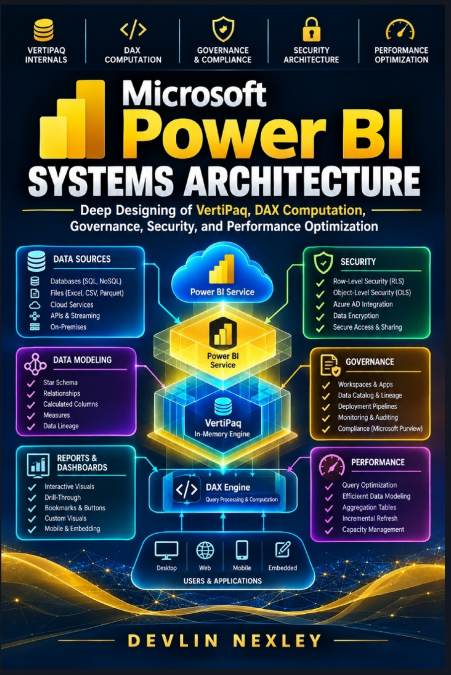
  • Microsoft Power BI Systems Architecture
    Devlin Nexley
    Modern business intelligence platforms are no longer limited to producing dashboards and reports. At enterprise scale, Power BI becomes a data and analytics engineering platform where semantic models, columnar storage, DAX computation, security, governance, deployment, and capacity management must work together as a coherent architecture.This book provides a deep technical exam...
    Disponible

    33,04 €

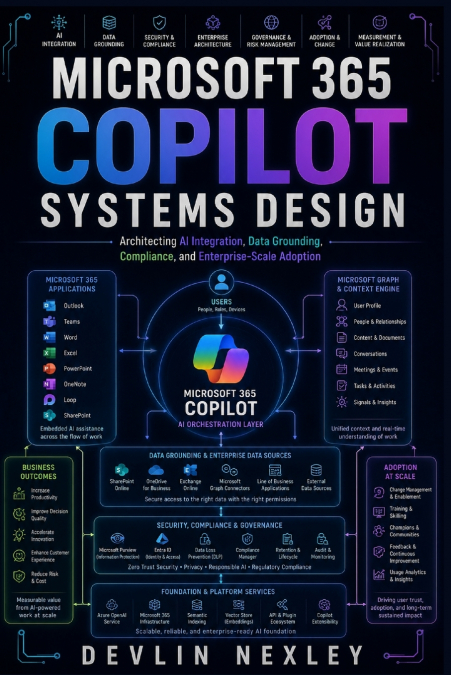
  • Microsoft 365 Copilot Systems Design
    Devlin Nexley
    Artificial intelligence is changing the way professionals write, analyze information, communicate, collaborate, and manage everyday work. Microsoft 365 Copilot brings these capabilities directly into the applications millions of people already use every day.This practical guide shows you how to use AI effectively across Word, Excel, PowerPoint, Outlook, and Teams to reduce repe...
    Disponible

    32,91 €

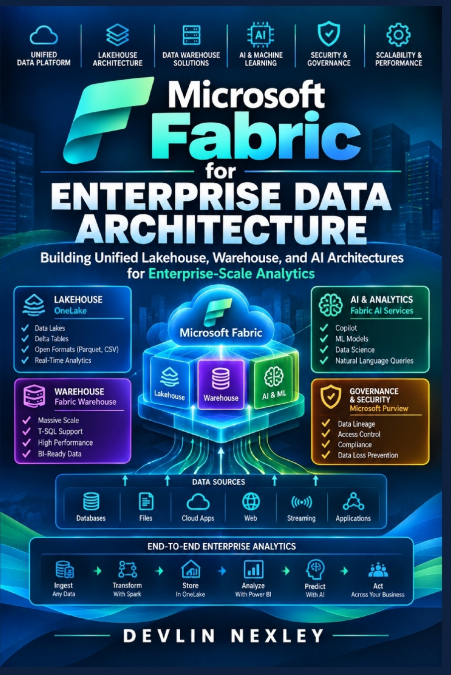
  • Microsoft Fabric for Enterprise Data Architecture
    Devlin Nexley
    Microsoft Fabric represents a significant shift in how modern organizations design and operate enterprise data platforms. Rather than treating data engineering, lakehouse processing, warehousing, real-time analytics, business intelligence, and AI as isolated systems, Fabric brings these workloads into a unified analytics architecture built around OneLake.This book examines Micr...
    Disponible

    33,20 €

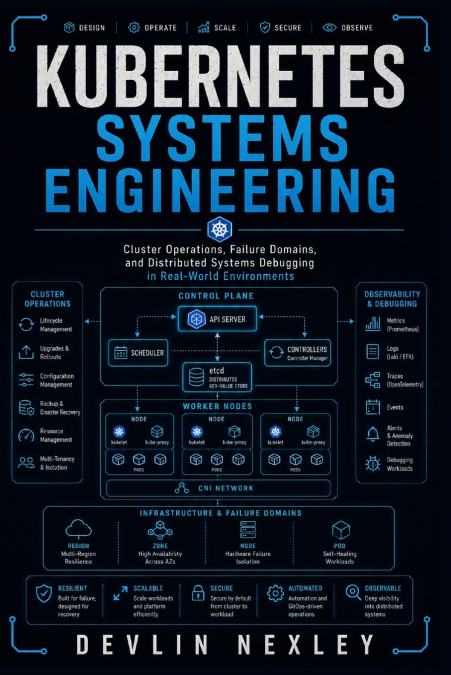
  • Kubernetes Systems Engineering
    Devlin Nexley
    Kubernetes is often described as a container orchestration platform. In production environments, it is something far more significant: a distributed control system responsible for continuously reconciling infrastructure state across thousands of interconnected components.Beneath every deployed workload lies a complex architecture of control loops, consensus-driven state managem...
    Disponible

    45,44 €

  • Notion AI for Organizational Intelligence
    Devlin Nexley
    Modern organizations do not suffer from a lack of information. They suffer from information that is fragmented, poorly structured, difficult to retrieve, inconsistently maintained, and disconnected from the decisions and workflows that depend on it.Building Intelligent Knowledge Systems with Notion AI presents a systems-oriented approach to designing knowledge environments that...
    Disponible

    39,24 €

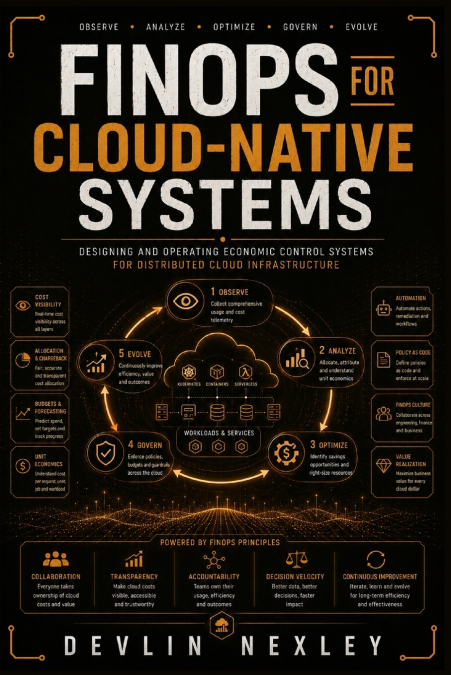
  • FinOps for Cloud-Native Systems
    Devlin Nexley
    Cloud FinOps Engineering redefines FinOps as a distributed systems discipline for the cloud-native era. Rather than treating cloud cost as a financial reporting problem, this book approaches it as a real-time system property that must be observed, modeled, controlled, and optimized alongside performance, reliability, and scalability.Modern cloud platforms generate enormous volu...
    Disponible

    32,91 €