Devlin Nexley
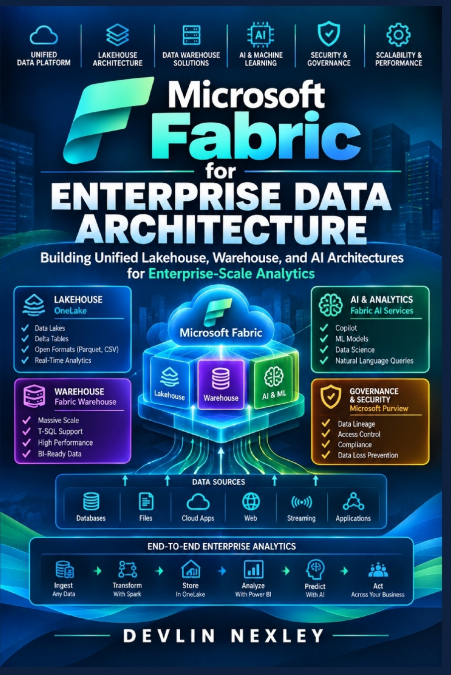
Microsoft Fabric represents a significant shift in how modern organizations design and operate enterprise data platforms. Rather than treating data engineering, lakehouse processing, warehousing, real-time analytics, business intelligence, and AI as isolated systems, Fabric brings these workloads into a unified analytics architecture built around OneLake.This book examines Microsoft Fabric from an enterprise engineering and architecture perspective. It goes beyond introductory feature descriptions to explore how Fabric components interact, how workloads should be structured, and how organizations can design scalable, governed, and operationally reliable data platforms.The book explores OneLake architecture, lakehouse engineering, Delta-based data processing, Apache Spark workloads, Fabric Data Factory, data warehousing, semantic models, real-time intelligence, data science, security, governance, capacity management, performance engineering, and AI integration. Particular attention is given to architectural boundaries, workload isolation, data lifecycle management, interoperability, observability, and the operational consequences of design decisions.Rather than presenting Fabric as a collection of independent services, the book examines it as an integrated enterprise data platform. It explores how organizations can establish domain-oriented data products, implement federated analytics operating models, integrate hybrid and multi-cloud environments, and modernize legacy data estates without creating new silos.Performance and reliability receive equal attention. The discussion covers capacity planning, query behavior, distributed processing, ingestion architecture, workload contention, pipeline resilience, data quality, semantic consistency, and the challenges that emerge when Fabric environments grow across business units and analytical domains.The book also examines Fabric’s role in AI-enabled data architectures, including the relationship between governed enterprise data, semantic models, machine learning workloads, generative AI, and emerging intelligent analytics capabilities. The emphasis is on architectural implications rather than AI marketing narratives.Who This Book Is ForThis book is intended for data architects, cloud architects, data engineers, analytics engineers, platform engineers, BI architects, AI engineers, enterprise architects, and technology leaders responsible for designing or operating modern enterprise data platforms.It is particularly useful for professionals evaluating Microsoft Fabric for enterprise adoption, modernizing existing analytics estates, consolidating fragmented data infrastructure, establishing governance models, or designing scalable foundations for analytics and AI.The objective is not simply to explain what Microsoft Fabric provides, but to examine how its capabilities can be engineered into production-grade enterprise systems-and where architectural decisions, operational constraints, and organizational realities determine whether those systems remain scalable and maintainable over time.