Devlin Nexley
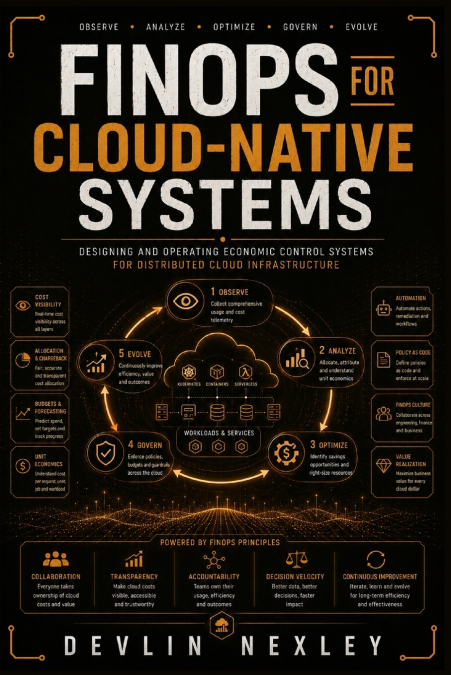
Cloud FinOps Engineering redefines FinOps as a distributed systems discipline for the cloud-native era. Rather than treating cloud cost as a financial reporting problem, this book approaches it as a real-time system property that must be observed, modeled, controlled, and optimized alongside performance, reliability, and scalability.Modern cloud platforms generate enormous volumes of telemetry, billing events, resource allocation records, and operational signals. As organizations adopt microservices, Kubernetes, multi-cloud architectures, and elastic infrastructure, economic behavior becomes increasingly difficult to understand using traditional budgeting and cost management approaches. Cost emerges from complex interactions among workload scheduling, resource provisioning, storage architectures, network topologies, service dependencies, and runtime demand patterns.This book explores how to build FinOps systems as economic control planes for large-scale distributed infrastructure. Drawing from principles of distributed systems design, observability engineering, data platform architecture, control theory, and cloud-native operations, it presents a systematic framework for understanding and managing the economics of modern cloud environments.Readers will learn how cloud providers meter and bill infrastructure services, how cost signals propagate through distributed architectures, and how engineering teams can construct real-time cost observability platforms that integrate metrics, logs, traces, and billing data into a unified economic model. The book examines the challenges of service-level cost attribution, multi-tenant resource allocation, Kubernetes workload accounting, and unit economics across complex microservice ecosystems.Beyond visibility, the book focuses on the design of intelligent optimization systems capable of forecasting demand, detecting anomalies, enforcing policy-as-code governance, and automating cost-aware infrastructure decisions. Through architecture-driven discussions, readers will explore closed-loop control systems that continuously balance cost, performance, reliability, and operational constraints in dynamic cloud environments.Topics include:FinOps as a distributed systems and control-plane disciplineCloud billing, metering, and pricing system internalsReal-time cost observability architecturesMetrics, logs, traces, and billing data correlationCost attribution models for shared infrastructureUnit economics for microservices and cloud-native platformsCost propagation through service dependency graphsCapacity planning and economic optimization strategiesKubernetes cost allocation and workload accountingCompute, storage, and network cost engineeringCost forecasting and anomaly detection systemsPolicy-as-code governance for cloud infrastructureClosed-loop optimization and autonomous FinOps platformsAI-assisted infrastructure optimization systemsEconomic-aware scheduling and resource managementThe future of self-optimizing cloud infrastructureWritten for platform engineers, site reliability engineers, cloud architects, infrastructure engineers, distributed systems practitioners, and FinOps professionals, this book provides a deep technical examination of how cloud economics can be embedded directly into the architecture and operation of modern distributed systems.